
PhD in Agriculture: Research to Real-World Impact
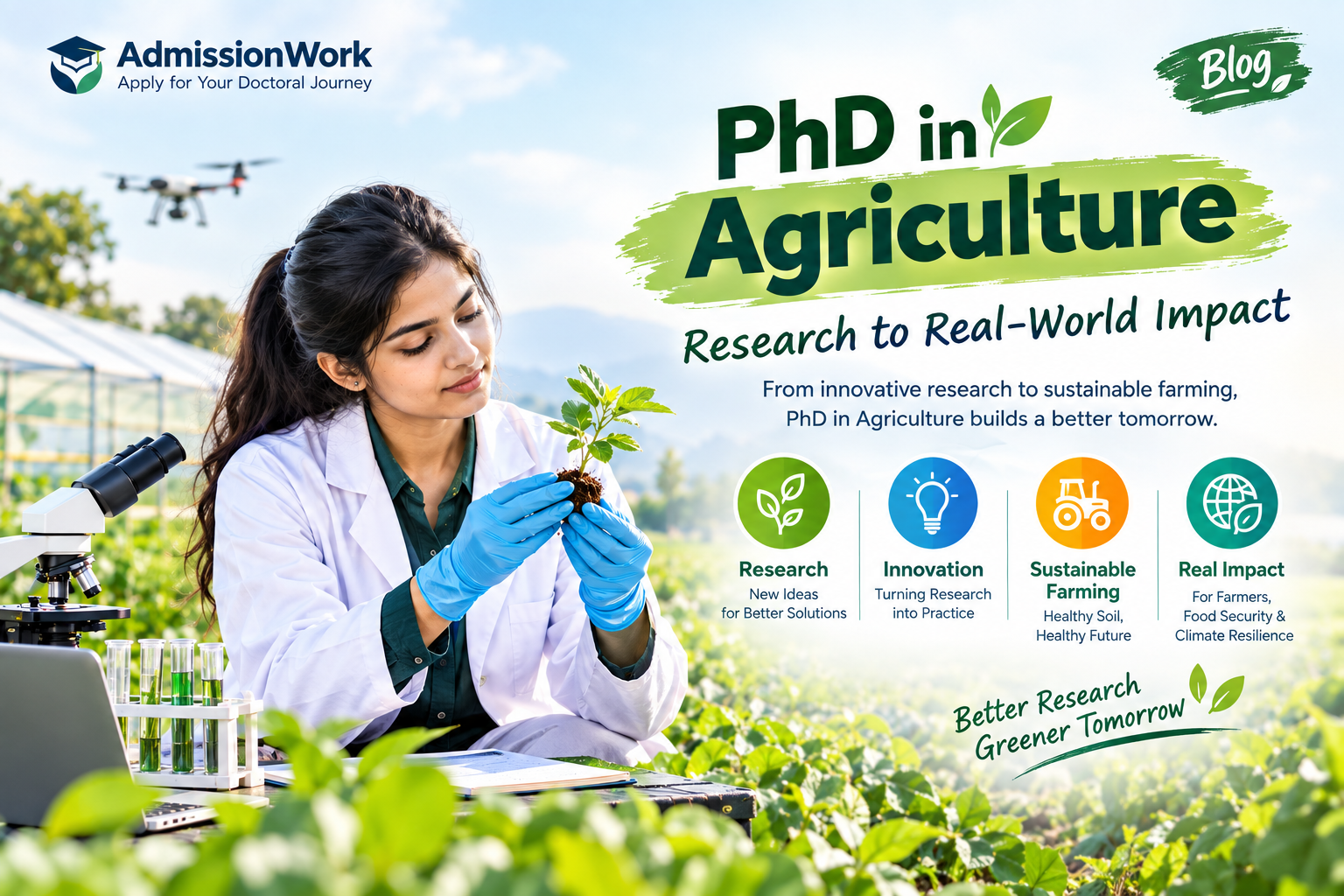
From Research Question to Real-World Impact: PhD in Agriculture
Discover how agricultural research can move from a simple question to meaningful ideas, scientific discoveries and practical solutions for the future of agriculture.
Every important research project begins with a question. In agriculture, that question may come from a challenge observed in a field, a laboratory, a farming community or an emerging technology.
A PhD in Agriculture gives researchers an opportunity to explore such questions systematically, understand existing knowledge and investigate new possibilities. The journey can involve literature review, experimentation, data analysis, field studies and the development of evidence-based conclusions.
But doctoral research is not only about writing a thesis. Agricultural research can also explore how scientific knowledge may contribute to areas such as sustainable farming, crop productivity, soil health, food security and agricultural technology.
What Does a PhD in Agriculture Involve?
A PhD in Agriculture is an advanced research programme in which scholars investigate a specific topic within agricultural science or a related discipline.
Depending on the university and specialization, research may involve areas such as:
- Agronomy
- Horticulture
- Soil Science
- Plant Breeding and Genetics
- Plant Pathology
- Agricultural Biotechnology
- Agricultural Economics
- Agricultural Engineering
- Precision Agriculture
- Sustainable Agriculture
- Climate-Smart Agriculture
- Agricultural Technology
Where Does an Agriculture Research Question Come From?
Research questions can emerge from many sources. A researcher may notice an unresolved agricultural problem, identify a gap in published research or explore how a new technology could address an existing challenge.
Problems Observed in Agriculture
Issues related to crop productivity, soil degradation, water availability, plant diseases and changing environmental conditions can lead to potential research questions.
Existing Research Gaps
Reading academic literature can help researchers understand what has already been studied and where further investigation may be useful.
New Technologies
Artificial intelligence, sensors, drones, remote sensing, biotechnology and data analytics are creating new possibilities for agricultural research.
From Question to Research Problem
A broad idea needs to be converted into a specific and researchable problem.
For example, instead of simply asking:
a researcher may develop a more focused question around a particular crop, region, farming system, environmental variable or agricultural practice.
The final research problem should be specific enough to study using appropriate methods and available resources.
The Agriculture PhD Research Journey
Important Research Areas in Agriculture
Agriculture is a multidisciplinary field. Researchers can explore traditional agricultural sciences as well as emerging technologies.
How Technology Is Changing Agricultural Research
Technology is creating new ways to collect, process and interpret agricultural information.
Artificial Intelligence
AI-based research can explore areas such as crop monitoring, disease identification, yield prediction and agricultural decision-support systems.
Drones and Remote Sensing
Aerial imagery and remote sensing technologies can provide researchers with new ways to study crop conditions and agricultural landscapes.
Agricultural Sensors
Sensors can support research involving soil moisture, environmental conditions, crop health and resource management.
Data Analytics
Agricultural datasets can be analysed to identify patterns, relationships and trends that may support research conclusions.
Turning Research Findings Into Real-World Impact
The transition from research findings to practical impact depends on the nature of the research, evidence obtained, feasibility and how findings are communicated and adopted.
Depending on the research area, findings may contribute to:
- Improved understanding of agricultural problems
- Better crop management practices
- More efficient use of agricultural resources
- New agricultural technologies
- Improved disease management approaches
- Sustainable farming strategies
- Evidence for agricultural decision-making
How to Choose a PhD Research Topic in Agriculture
Selecting a research topic is an important step in the doctoral journey.
Consider the following questions:
- What agricultural problem interests you?
- What does existing research say about the problem?
- What research gaps can you identify?
- Can the proposed research be completed with available resources?
- What methods could be used to investigate the problem?
- What contribution could the research potentially make?
Preparing a PhD Research Proposal
A research proposal helps explain the research idea, problem, objectives and proposed methodology.
Depending on university requirements, a proposal may include:
- Research Title
- Introduction and Background
- Research Problem
- Research Gap
- Research Objectives
- Research Questions
- Literature Review
- Research Methodology
- Expected Outcomes
- References
PhD in Agriculture and Career Development
A doctoral degree can support research-oriented career paths across academia, scientific research, agricultural technology, agribusiness and related sectors.
Depending on qualifications, specialization and experience, possible career directions can include:
- Academic research
- University teaching
- Agricultural research institutions
- Scientific research
- Agricultural technology
- Biotechnology research
- Food and agriculture research
- Rural development research
- Agricultural consultancy
- Sustainable agriculture projects
What Makes Agricultural Research Meaningful?
Meaningful research is not defined only by the size of a project. A focused study can contribute useful knowledge when it addresses a clearly defined question using an appropriate research approach.
Strong agricultural research generally begins with a clear problem, uses suitable evidence and communicates its findings responsibly.
A Simple Roadmap for Aspiring Agriculture Researchers
Frequently Asked Questions
What is a PhD in Agriculture?
A PhD in Agriculture is an advanced research degree focused on investigating a specific topic in agricultural sciences or a related discipline.
What are popular Agriculture PhD research areas?
Research areas can include agronomy, horticulture, soil science, plant biotechnology, plant pathology, agricultural economics, precision agriculture and sustainable agriculture.
How do I choose an Agriculture PhD research topic?
Start with an area of interest, review existing research, identify a research gap and develop a focused, feasible research question.
What should an Agriculture PhD research proposal contain?
A research proposal may include the title, background, research problem, research gap, objectives, literature review, methodology, expected outcomes and references.
Can agricultural research have practical applications?
Depending on the research question and findings, agricultural research can contribute knowledge relevant to farming practices, technologies, resource management, sustainability and other applications.
Can working professionals pursue a PhD in Agriculture?
Study options depend on the university and programme. Working professionals should check the current eligibility, attendance and programme requirements before applying.
Your Research Question Could Be the Beginning of Something Bigger
Planning your PhD journey in Agriculture? Explore PhD admission information, research guidance, synopsis preparation and doctoral resources with AdmissionWork.
Explore AdmissionWorkLooking for PhD Admission Guidance?
Get free synopsis evaluation & university recommendations.
AdmissionWork
Education & Research Expert • AdmissionWork
Specialist in doctoral research consulting, UGC compliance protocols, and thesis formulation.