
PhD in Agriculture in India: Admission Guide 2026-27
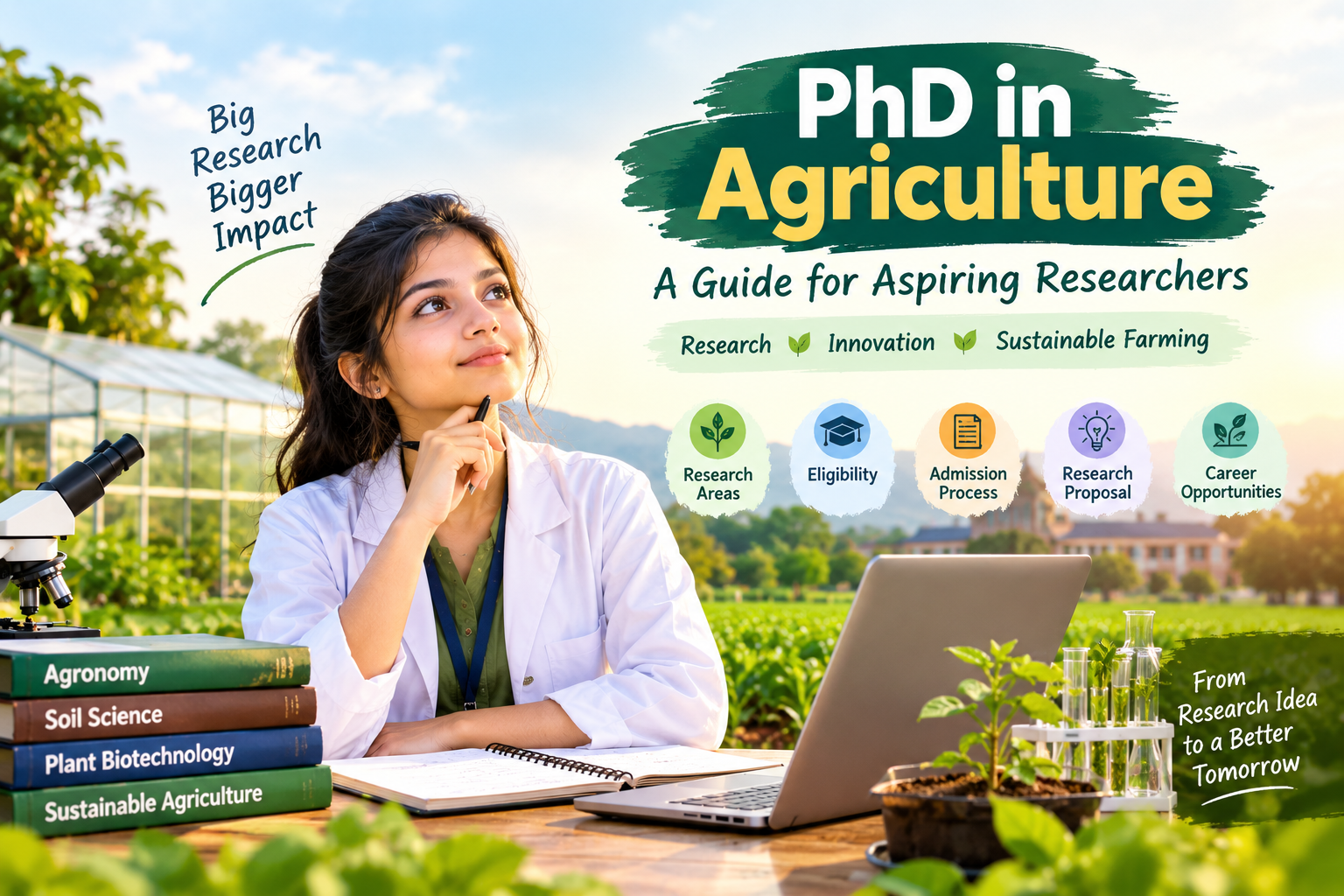
PhD in Agriculture: A Guide for Aspiring Researchers
Explore research areas, eligibility, admission process, research proposal preparation and career opportunities in agricultural research.
Agriculture is evolving rapidly with advances in technology, climate-smart farming, biotechnology, food security, sustainable agriculture and data-driven research. For students and working professionals interested in these areas, a PhD in Agriculture can provide an opportunity to develop advanced research skills and contribute to important agricultural challenges.
If you are planning to pursue a doctoral degree in agriculture, understanding research areas, eligibility, admission requirements, research proposal preparation and the overall doctoral journey can help you prepare more effectively.
What Is a PhD in Agriculture?
A PhD in Agriculture is a doctoral-level research programme focused on advanced study and original research in agricultural sciences and related disciplines.
Depending on the university and specialization, agricultural research may cover several different areas.
- Agronomy
- Horticulture
- Soil Science
- Agricultural Economics
- Plant Breeding and Genetics
- Plant Pathology
- Entomology
- Agricultural Extension
- Agricultural Engineering
- Seed Science
- Agricultural Biotechnology
- Precision Agriculture
- Sustainable Agriculture
Why Choose a PhD in Agriculture?
Agriculture is connected with major challenges such as food security, climate change, water management, soil health, sustainable farming and rural development.
A doctoral programme allows researchers to investigate these challenges in depth and develop specialized knowledge.
- Build advanced agricultural research skills
- Develop expertise in a specialized research area
- Explore sustainable farming practices
- Study agricultural biotechnology
- Research climate-smart agriculture
- Work on food security challenges
- Explore agricultural technology
- Develop academic and scientific expertise
Popular PhD Research Areas in Agriculture
1. Sustainable Agriculture
Sustainable agriculture focuses on improving agricultural productivity while managing environmental and natural resources responsibly.
- Organic farming systems
- Soil conservation
- Resource-efficient agriculture
- Sustainable irrigation
- Climate-resilient farming
2. Agricultural Biotechnology
Biotechnology is an important area of modern agricultural research, with applications in crop improvement and plant science.
- Plant biotechnology
- Molecular breeding
- Crop improvement
- Genetic research
- Disease-resistant crops
3. Agronomy
Agronomy focuses on crop production, soil management and efficient agricultural systems.
- Crop productivity
- Cropping systems
- Weed management
- Nutrient management
- Climate-resilient crops
4. Soil Science
Soil health plays an important role in agricultural productivity. Researchers can explore soil fertility, conservation and nutrient management.
5. Plant Pathology
Plant pathology examines plant diseases and their causes, detection and management.
6. Agricultural Economics
Agricultural economics combines agriculture with economic analysis and can include research on farm income, markets, rural development and agricultural supply chains.
7. Precision Agriculture
Modern technologies such as sensors, GIS, drones, satellite imagery and data analytics are creating new opportunities for agricultural research.
PhD in Agriculture Eligibility
Eligibility requirements can vary between universities, programmes and admission routes. Candidates should always check the latest requirements published by the university before applying.
Depending on the programme, applicants may need:
- A relevant postgraduate qualification
- Required minimum marks or equivalent qualification
- Relevant academic background
- Research proposal or synopsis, where required
- Entrance examination qualification, where applicable
- Interview or research presentation, where applicable
PhD Admission Process in Agriculture
The exact admission process depends on the university, but a typical doctoral admission journey may include the following stages.
How to Choose a PhD Research Topic in Agriculture
Choosing a research topic is one of the most important parts of your doctoral journey.
A useful research topic should ideally be:
Instead of selecting a very broad topic such as "Agriculture and Climate Change", a researcher could explore a more focused question related to crop productivity, water-use efficiency, climate variability or another specific agricultural issue.
How to Prepare a PhD Research Proposal
A research proposal should clearly communicate what you want to study, why the research matters and how you plan to conduct the study.
Important Components
- Research Title
- Introduction
- Research Problem
- Research Gap
- Research Objectives
- Research Questions
- Proposed Methodology
- Expected Outcomes
- References
Skills That Can Help Agriculture PhD Researchers
A successful doctoral journey requires more than subject knowledge. Researchers can benefit from developing the following skills:
- Research methodology
- Academic writing
- Literature review
- Data analysis
- Statistical analysis
- Critical thinking
- Scientific communication
- Research presentation
- Academic publishing
PhD in Agriculture for Working Professionals
Professionals working in agriculture, education, research, agribusiness or related areas may consider doctoral study to develop advanced research expertise.
Study options and requirements vary between universities. Working professionals should carefully check:
- Programme requirements
- Attendance requirements
- Coursework
- Research expectations
- Available study format
- Research facilities
- Time commitment
Career Opportunities After a PhD in Agriculture
A doctoral degree in agriculture can support research, academic, scientific and technology-oriented career paths.
- University teaching
- Agricultural research
- Scientific research
- Research institutions
- Agricultural technology
- Agribusiness research
- Agricultural consultancy
- Food and agriculture research
- Rural development
- Agricultural policy research
- Biotechnology research
- Sustainable agriculture projects
Emerging Agriculture Research Trends
Artificial Intelligence in Agriculture
AI-based systems are creating research opportunities in areas such as crop monitoring, disease detection, yield prediction and agricultural decision support.
Climate-Smart Agriculture
Researchers can explore farming systems designed to improve resilience to changing climatic conditions.
Precision Farming
Sensors, drones, satellite imagery, GIS and data analytics are opening new possibilities for precision agriculture research.
Smart Irrigation
Research can examine technology-assisted approaches to improve water-use efficiency in agriculture.
Sustainable Food Systems
Researchers can study how agricultural production, food processing and distribution can become more sustainable.
Common Mistakes to Avoid During PhD Admission
- Choosing a topic without reviewing existing research.
- Selecting a university without checking current requirements.
- Preparing an overly broad research proposal.
- Ignoring the research gap.
- Copying research proposals from the internet.
- Not understanding the proposed methodology.
- Applying without checking eligibility.
- Waiting until the last moment to prepare documents.
- Focusing only on admission instead of research preparation.
- Not preparing adequately for the research interview.
PhD in Agriculture: A Simple Roadmap
Frequently Asked Questions
Is a PhD in Agriculture a good option for researchers?
A PhD can be suitable for candidates who want to develop advanced research expertise and pursue academic, scientific or research-oriented careers in agriculture.
What can I research in a PhD in Agriculture?
Research areas can include agronomy, horticulture, soil science, agricultural biotechnology, plant pathology, agricultural economics, precision agriculture and sustainable agriculture.
Can working professionals pursue a PhD in Agriculture?
Depending on the university and programme, working professionals may have doctoral study options. Candidates should check the current university requirements before applying.
Is a research proposal required for PhD admission?
Some universities require a research proposal or synopsis, while requirements vary by institution and admission route.
How do I choose a PhD topic in Agriculture?
Start with an area that interests you, review existing research, identify a research gap and narrow the idea into a specific and feasible research problem.
What should a PhD research proposal contain?
A proposal commonly includes the research title, introduction, research problem, research gap, objectives, methodology, expected outcomes and references.
Start Your PhD Journey With the Right Research Idea
Planning your PhD Admission 2026-27? Explore PhD admission guidance, research topics, synopsis preparation and doctoral study resources with AdmissionWork.
Explore AdmissionWorkLooking for PhD Admission Guidance?
Get free synopsis evaluation & university recommendations.
AdmissionWork
Education & Research Expert • AdmissionWork
Specialist in doctoral research consulting, UGC compliance protocols, and thesis formulation.