
PhD Admission in India: Complete Roadmap 2026–27
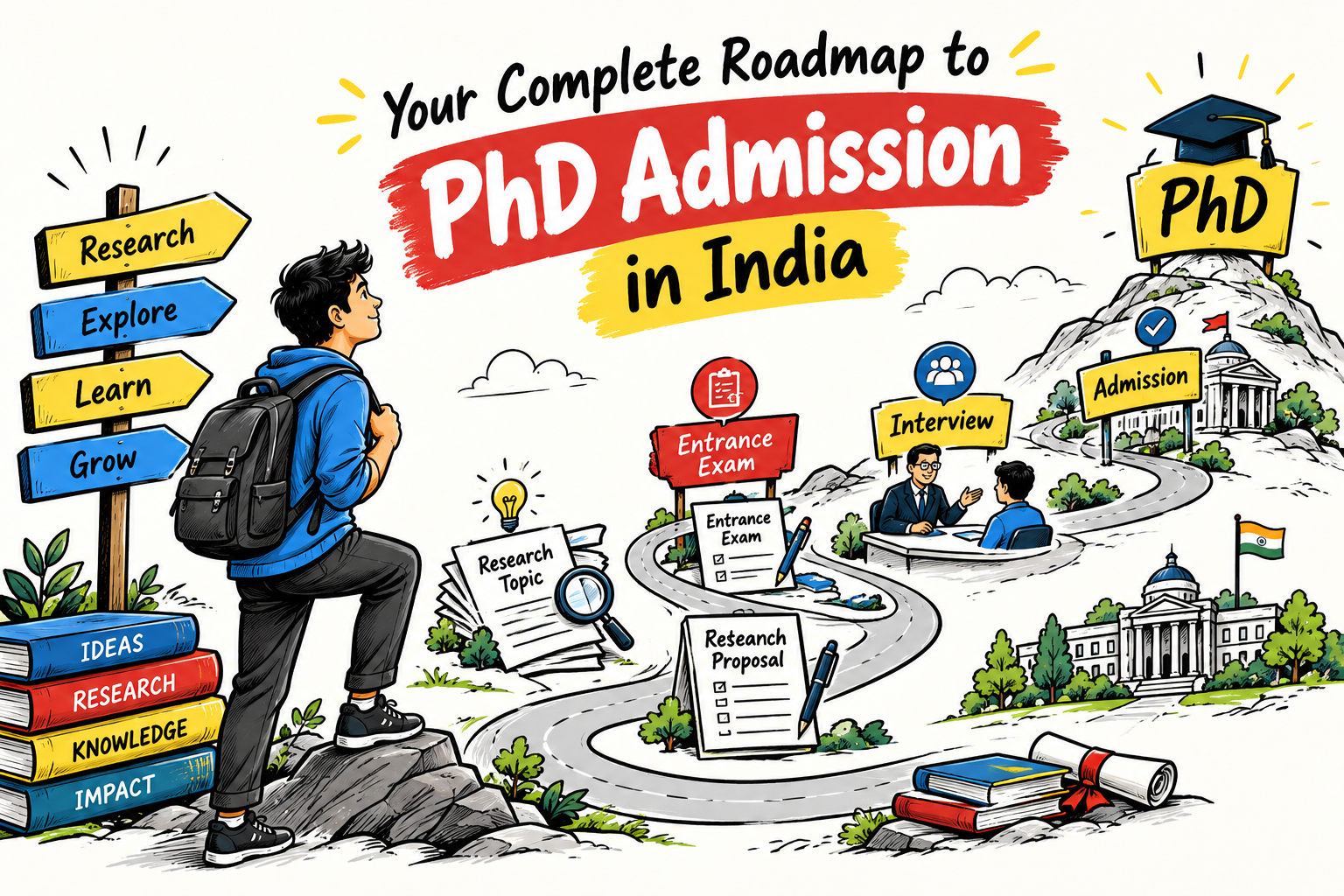
Your Complete Roadmap to PhD Admission in India
A PhD is more than another academic qualification. It is a journey of questions, research, discovery and personal growth. For many students and working professionals, the biggest challenge is not deciding to pursue a PhD—it is understanding where to begin.
If you are planning PhD admission in India, this guide will help you understand the major stages of the journey, from choosing a research area to selecting a university, preparing your research proposal and getting ready for the admission process.
Why Start Your PhD Journey With a Clear Roadmap?
A PhD requires long-term commitment. Unlike a conventional degree, doctoral research involves identifying a meaningful research problem, studying existing literature, developing a research methodology and contributing something new to your field.
Having a clear roadmap can make the process easier to understand. It can help you organize your research goals, compare university options, prepare the required documents and approach the admission process with greater confidence.
Whether you are a recent postgraduate, a working professional or someone returning to academics after a gap, planning your PhD journey carefully can help you make informed decisions.
Step 1: Understand Why You Want to Pursue a PhD
Before looking for universities or filling out applications, take some time to understand your reason for pursuing doctoral research.
Ask yourself:
- What research problem interests me?
- Which academic or professional field do I want to explore?
- Do I want to build a career in academia or research?
- Can I commit the required time to doctoral research?
- How can a PhD support my long-term career goals?
Your answers can help you choose a research direction that is meaningful to you rather than simply selecting a topic because it is currently popular.
Step 2: Choose Your Research Area
Your research area becomes the foundation of your doctoral journey. Instead of immediately searching for a final research title, begin by identifying a broader subject that genuinely interests you.
Depending on your academic background, your area may be related to Arts, Science, Commerce, Management, Law, Agriculture, Engineering, Technology, Pharmacy, Yoga, Naturopathy or another specialized discipline.
Once you identify your area, explore recent research papers, existing studies and unresolved problems. This can help you gradually convert a broad interest into a focused research question.
Step 3: Find a Strong PhD Research Topic
A good research topic is not simply a complicated title. It should represent a genuine research problem that can be studied using a suitable methodology.
A potential PhD topic should ideally be:
- Relevant to your academic or professional field
- Researchable within the available time and resources
- Supported by sufficient literature
- Specific enough to investigate properly
- Capable of producing meaningful findings
Start with a question. What problem do you want to understand? What gap exists in current knowledge? What could your research contribute?
Your answers can gradually lead you toward a stronger research topic.
Step 4: Check PhD Eligibility Requirements
PhD eligibility can vary depending on the university, discipline and applicable admission regulations. Therefore, candidates should always check the current requirements of the university or institution they intend to apply to.
Requirements may include relevant postgraduate qualifications, minimum academic marks, entrance examinations, research proposals, interviews or other university-specific conditions.
If you have a gap after graduation or postgraduate study, do not assume that it automatically prevents you from pursuing a PhD. Eligibility depends on the specific rules of the institution and programme.
Step 5: Explore PhD Universities in India
Choosing a university is one of the most important decisions in the doctoral journey. Do not select an institution based only on its name. Consider whether the university and its research environment are suitable for your goals.
While comparing universities, consider:
- Availability of your research area
- Faculty and potential research supervisors
- Research facilities and academic resources
- Programme structure
- Admission requirements
- Duration and academic requirements
- Location and accessibility
- Fees and financial considerations
- Recognition and applicable regulatory requirements
Proper university research can save time and help you focus on programmes that actually match your research interests.
For guidance on exploring your options, visit AdmissionWork .
Step 6: Understand the PhD Admission Process
The exact admission process differs between universities and programmes. However, a typical doctoral admission journey may involve several stages.
- Identify a suitable PhD programme.
- Check the university's eligibility criteria.
- Prepare the required academic and personal documents.
- Develop your research proposal or synopsis if required.
- Complete the application process.
- Appear for an entrance examination if applicable.
- Prepare for the research interview or presentation.
- Complete the university's admission and registration requirements.
Always follow the current instructions published by the university for the programme you are applying to.
Step 7: Prepare Your Research Proposal or Synopsis
A research proposal is one of the most important parts of many PhD admission processes. It gives the university an initial understanding of what you want to research and how you intend to approach the problem.
A research proposal may include:
- Proposed research title
- Introduction and background
- Research problem
- Research gap
- Research objectives
- Research questions or hypotheses, where appropriate
- Literature review
- Proposed methodology
- Expected contribution
- References
The structure and requirements can vary by university and discipline. Your proposal should therefore be prepared according to the relevant university's instructions.
If you need help understanding how to structure your research idea, explore PhD guidance resources at AdmissionWork .
Step 8: Prepare for the PhD Entrance Exam
Some universities may use an entrance examination as part of their PhD admission process. The syllabus and examination pattern can vary.
Depending on the programme, preparation may involve research methodology, subject-specific knowledge, academic concepts and related areas.
Read the official notification carefully and prepare according to the prescribed syllabus rather than relying on a generic preparation plan.
Step 9: Get Ready for the Research Interview
The interview is an opportunity to explain your research interest, academic background and understanding of your proposed topic.
Be prepared to discuss:
- Why you selected the research topic
- The problem you want to investigate
- What existing research says about the topic
- The research gap you have identified
- Your proposed methodology
- The expected contribution of your research
- Why the selected university or research environment interests you
You do not need to memorize every sentence of your proposal. Focus on understanding your research idea and being able to explain it clearly.
Step 10: Prepare Your PhD Documents
Keeping your documents organized before applications open can make the admission process much smoother.
Depending on the university, you may need documents such as:
- Academic certificates and marksheets
- Identity proof
- Photograph and signature
- Postgraduate qualification documents
- Research proposal or synopsis
- Entrance examination documents, where applicable
- Category or other supporting certificates, where applicable
- Experience documents, where required
The exact document list should always be confirmed from the official admission notification of the university.
Step 11: Can Working Professionals Pursue a PhD?
Many professionals consider doctoral research as a way to deepen their expertise and build an academic or research-oriented career.
Depending on the institution and programme rules, PhD programmes may have different study arrangements. Some programmes may provide options suitable for candidates who are working, while others may have specific attendance or residency requirements.
Working professionals should carefully check the current university regulations before applying and ensure that the programme's requirements are compatible with their professional responsibilities.
Step 12: What About a Gap Year?
A gap in your academic or professional journey does not necessarily answer the question of whether you can pursue a PhD. What matters is the eligibility criteria and admission rules applicable to the specific university and programme.
If you have taken a career break, spent time working, changed fields or returned to education after several years, focus on understanding the current admission requirements and how your background connects with your proposed research.
Step 13: Think About Your Long-Term Research Career
A PhD is a long-term research commitment, so it is useful to think beyond admission.
Depending on your field and career goals, doctoral research can support opportunities related to academia, research, higher education, industry, consulting, policy, innovation and specialized professional roles.
Your career direction can also influence your choice of research area, university and supervisor.
Common Mistakes to Avoid During PhD Admission
A well-planned application can help you avoid unnecessary problems. Some common mistakes include:
- Choosing a topic without understanding the research problem
- Applying without checking current eligibility requirements
- Selecting a university without researching the programme
- Using a generic research proposal for every application
- Ignoring the official admission notification
- Waiting until the last date to prepare documents
- Not preparing for the research interview
- Focusing only on the degree instead of the research journey
How AdmissionWork Can Help With Your PhD Journey
Starting a PhD can feel overwhelming when you are trying to manage research ideas, university options, documentation and admission requirements at the same time.
AdmissionWork is designed to help students and professionals understand their PhD journey and explore available admission and research guidance options.
From understanding your research direction to exploring university options and preparing for the admission journey, having structured guidance can make the process easier to navigate.
Your PhD Journey Starts With One Step
A doctoral journey does not begin on the day you receive your admission letter. It begins much earlier—with a question, an idea and the willingness to investigate something deeply.
Start by understanding your research interests. Explore relevant universities. Check eligibility requirements. Develop your research idea. Prepare your documents and understand the admission process.
Most importantly, choose your path carefully and rely on current, official university information when making admission decisions.
If you are planning your PhD admission in India for 2026–27, begin your journey with a clear research goal and a practical admission roadmap.
Ready to Explore Your PhD Journey?
Explore PhD admission guidance, research resources and university options with AdmissionWork.
Explore AdmissionWorkFrequently Asked Questions About PhD Admission in India
What is the first step for PhD admission?
The first step is to identify your research area and understand the eligibility and admission requirements of suitable universities.
Can I pursue a PhD after a postgraduate degree?
Many PhD programmes require a relevant postgraduate qualification, but eligibility criteria vary by university and programme.
Is a research proposal required for PhD admission?
Some universities require a research proposal or synopsis as part of their admission process, while requirements can differ between programmes.
Can working professionals pursue a PhD?
Some institutions offer doctoral study arrangements that may be suitable for working professionals. Candidates should check the current rules of the specific university and programme.
Does a gap year affect PhD admission?
A gap does not by itself determine eligibility in every programme. Candidates should check the specific university's current admission criteria.
How long does a PhD take?
The duration varies according to the university, discipline, research progress and applicable regulations. Always check the programme's current rules.
How should I choose a PhD university?
Compare research areas, faculty, programme requirements, research facilities, fees, location and the university's applicable recognition and regulatory requirements.
Looking for PhD Admission Guidance?
Get free synopsis evaluation & university recommendations.
AdmissionWork
Education & Research Expert • AdmissionWork
Specialist in doctoral research consulting, UGC compliance protocols, and thesis formulation.