
PhD Admission After Master's Degree: Complete Guide
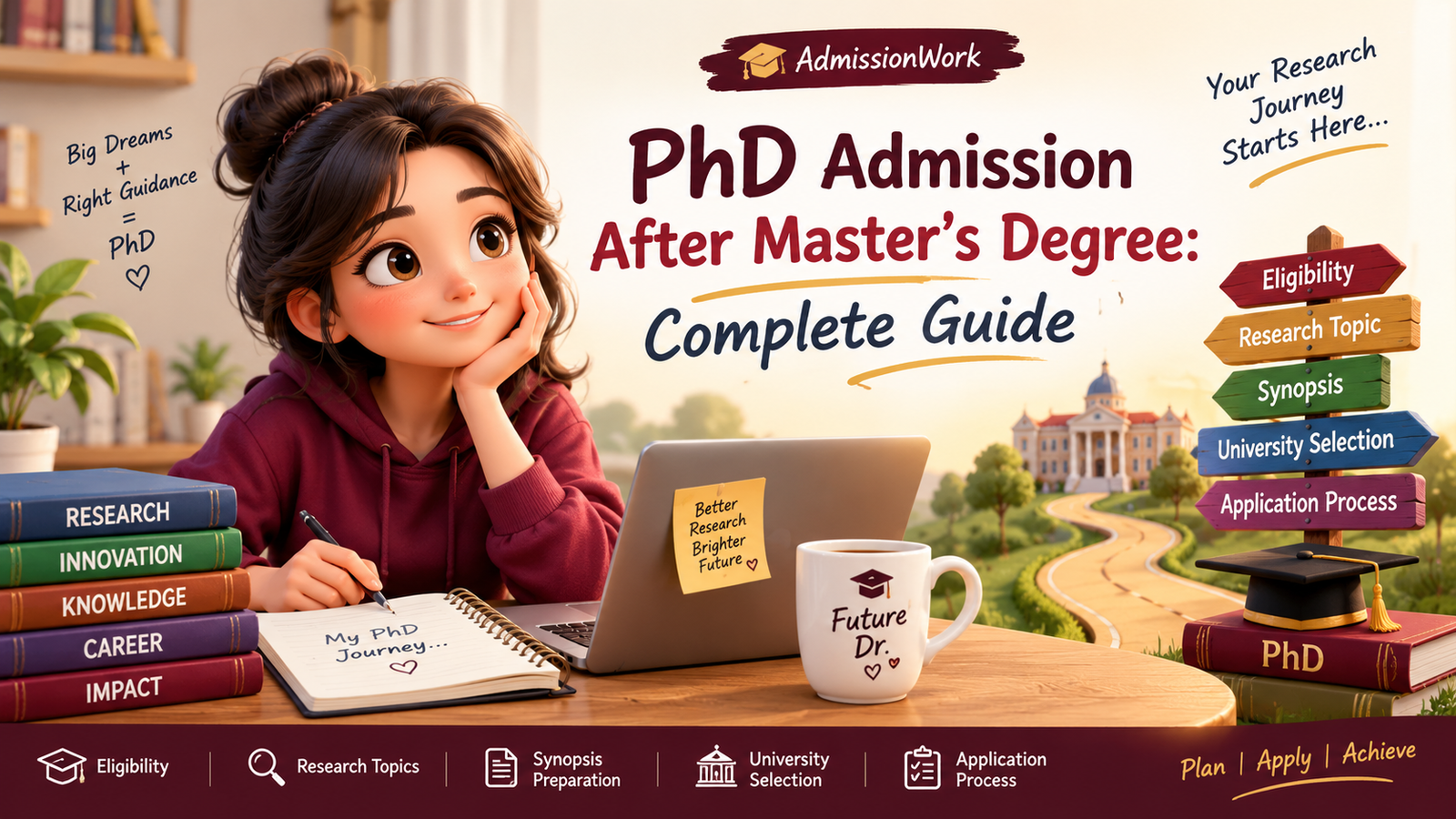
Your Master's Degree Is Complete—What's Next? A Guide to PhD Admission
Finished your postgraduate degree and thinking about what comes next? Discover how PhD admission works, how to explore research interests, and what to consider before starting your doctoral journey.
Completing your master's degree is an important academic milestone. You have spent years studying your subject, preparing assignments, completing projects and developing specialist knowledge. Now you may be asking an important question: What should I do next?
Some graduates choose employment, competitive examinations or professional certifications. Others decide to continue their academic journey through a Doctor of Philosophy (PhD). A PhD is a research-focused qualification that involves investigating a specific question or problem and contributing to knowledge in a chosen field.
If research interests you, this guide will help you understand the steps involved in planning for PhD admission in India and preparing for the next stage of your academic journey.
1. First, Understand What You Want From Your Career
Before selecting a university or filling out an application, take time to think about your professional goals. A PhD requires sustained effort, independent learning and a willingness to work through challenging research questions.
Ask yourself these questions:
- Do I enjoy studying a subject in depth?
- Am I interested in investigating problems and analysing evidence?
- Would I like to explore teaching, research or specialist career paths?
- Can I commit sufficient time to a long-term academic project?
- Does a PhD align with the requirements of the career I want?
2. What Is a PhD, and How Is It Different From a Master's Degree?
A master's programme generally builds advanced knowledge and subject expertise. A PhD places greater emphasis on original research, critical analysis, academic independence and the development of a substantial research project.
Depending on your subject and university, doctoral research may involve:
- Identifying a research problem or unanswered question.
- Reviewing existing academic studies and literature.
- Developing research questions and an appropriate methodology.
- Collecting or analysing relevant data, texts, experiments or evidence.
- Writing a thesis and presenting your findings.
- Defending your research during the required evaluation or viva process.
The precise structure, duration and evaluation process depend on the applicable regulations and the university's approved PhD programme.
3. Check Your Eligibility for PhD Admission
Eligibility is one of the first things to investigate. Requirements can vary according to your discipline, previous qualification, marks, admission route and the regulations applicable to the institution.
Before applying, check the following:
- Academic qualification: Confirm whether your master's degree or another recognised qualification meets the programme's criteria.
- Minimum marks: Review the university's stated minimum percentage, grade or equivalent requirement.
- Entrance examination: Find out whether an entrance test is required or whether an applicable exemption is available.
- Interview: Check whether shortlisted candidates must attend a research interview or presentation.
- Subject requirements: Verify whether your previous degree is accepted for your intended research discipline.
- Current regulations: Check the latest official university admission notification and applicable UGC regulations.
Do not assume that every university follows the same criteria. Read the current admission prospectus carefully and obtain clarification from the university when a requirement is unclear.
4. Choose a Research Area That Matches Your Background
A research area connects your academic background with a subject you want to investigate more deeply. Choosing an area that genuinely interests you can help you stay engaged throughout the research process.
For example, postgraduate students may explore research directions such as:
- Arts and Humanities: literature, history, languages, culture and social thought.
- Science: laboratory research, theoretical studies, environmental science and applied scientific questions.
- Commerce and Management: consumer behaviour, finance, organisational studies, marketing and business strategy.
- Education: teaching methods, educational technology, curriculum development and learning outcomes.
- Agriculture: crop improvement, sustainable farming, soil health and agricultural innovation.
- Law: legal interpretation, public policy, jurisprudence and comparative legal studies.
- Engineering and Technology: emerging technologies, systems, materials, computing and applied innovation.
These are broad examples rather than guaranteed admission specialisations. Available research areas depend on the institution, department, supervisor expertise and current doctoral vacancies.
5. Turn Your Research Interest Into a Clear Topic
You do not need to solve a major problem on your first day of planning. Begin with a subject that interests you, then explore what researchers have already studied and where further investigation may be useful.
A practical way to develop your topic is to:
- Write down three to five subjects that interest you.
- Read recent academic papers, review articles and relevant books.
- Identify a specific problem, debate or research gap.
- Consider whether the question can be investigated with available time and resources.
- Discuss the idea with a suitable academic or potential research supervisor.
6. Understand the Role of a Research Synopsis
Some universities ask applicants to submit a research proposal or synopsis as part of the admission process. It helps explain what you want to study, why the subject matters and how you may investigate it.
A research synopsis commonly covers:
- Proposed title and introduction.
- Background and rationale for the study.
- Research problem and objectives.
- Research questions or hypotheses, where appropriate.
- Brief review of relevant literature.
- Proposed methodology and research design.
- Potential significance and limitations of the study.
- References in the required academic format.
Follow the format prescribed by the university. Requirements may differ between disciplines and institutions, and a proposal may need revision after discussion with the department or supervisor.
For more guidance, explore the AdmissionWork website for relevant PhD admission and research-planning resources.
7. How to Select the Right University for Your PhD
University selection should involve more than comparing names or advertisements. You need to determine whether the institution offers a suitable research environment and whether its programme matches your academic goals.
Before applying, investigate these factors:
- Recognition and authorisation: Verify the institution and programme information through official sources.
- Research supervision: Look for relevant faculty expertise and suitable supervision arrangements.
- Research facilities: Consider access to libraries, laboratories, databases, fieldwork or other necessary resources.
- Admission rules: Confirm eligibility, selection procedures and deadlines.
- Fees and funding: Understand tuition, other charges, available funding and any applicable conditions.
- Research requirements: Review coursework, progress reviews, thesis requirements and publication policies.
- Study format: Confirm whether the programme offers the mode of study you need and whether it is permitted under current rules.
Verify important claims directly through official university documents and applicable regulatory guidance. Do not rely only on social media posts, third-party promotions or verbal assurances.
8. Understand the PhD Admission Process
Although procedures vary, the following steps can help you organise your preparation for doctoral admission.
Research Your Options
Identify universities and departments that work in your intended research area. Read their official PhD admission notifications.
Check Eligibility and Deadlines
Confirm the academic criteria, entrance examination rules, application dates and required documents.
Prepare Your Documents
Organise academic marksheets, degree certificates, identification and other documents listed in the official application instructions.
Develop Your Research Proposal
If required, prepare a research synopsis according to the university's format and subject-specific expectations.
Complete the Application
Submit the required form, documents and application fee through the official process before the deadline.
Prepare for Selection
Where required, prepare for an entrance test, research presentation or interview. Be ready to explain your research interests clearly.
Review the Final Offer Carefully
Before accepting an offer or paying fees, verify the official admission status, programme conditions, fee details and next steps.
9. Can You Pursue a PhD While Working?
Some graduates want to continue their careers while pursuing doctoral research. Whether this is possible depends on the applicable regulations, university policy, programme structure and the candidate's circumstances.
Before choosing a part-time or other study arrangement, confirm that the university is permitted to offer that format under the current applicable rules. Discuss attendance, coursework, research meetings, workplace permissions and the expected time commitment.
Be realistic about your schedule. Research involves more than attending classes; it may require reading, data collection, analysis, writing and regular progress reviews.
10. What Skills Can Help You Prepare for a PhD?
You do not need to know everything before starting. However, building a few core skills can make the transition from postgraduate study to independent research more manageable.
- Academic reading: Learn to identify the main argument, methods and limitations of research papers.
- Critical thinking: Compare evidence and examine different explanations for a problem.
- Academic writing: Practise clear, structured and properly referenced writing.
- Research methods: Understand methods commonly used in your subject.
- Time management: Set realistic weekly research goals.
- Communication: Practise explaining your research question and its significance.
- Research integrity: Learn about citation, plagiarism prevention, ethical approval and responsible data handling.
11. Think About the Time, Cost and Commitment
Before enrolling, create a realistic plan for the financial and personal commitments involved. The total cost can include tuition, registration, travel, accommodation, research materials, fieldwork and other expenses.
Consider these questions:
- What are the complete fees listed by the university?
- Are scholarships, fellowships or other funding routes available?
- What conditions apply to any funding you may receive?
- How will you manage work, family responsibilities and research?
- What facilities and academic support will you need?
- What are the expected milestones and maximum permitted duration?
Funding availability, programme duration and other conditions vary. Confirm the latest details with the institution instead of relying on general estimates.
12. Common Mistakes to Avoid Before Applying
A little preparation can help you avoid unnecessary delays and make a more informed application.
- Choosing a university without verifying its official status and rules.
- Selecting a topic only because it sounds popular.
- Submitting a proposal without understanding the research problem.
- Assuming every institution has identical eligibility criteria.
- Missing application deadlines or overlooking required documents.
- Ignoring fees, funding conditions and the time commitment.
- Trusting guarantees of admission without checking the official process.
- Paying unofficial agents or individuals without verifying their authority.
13. Your Master's Degree Can Be the Starting Point
Your postgraduate qualification has helped you build a foundation in your chosen subject. If you decide to pursue a PhD, the next stage is to connect that foundation with a research question, a suitable academic environment and a realistic plan.
Start by exploring your interests, checking current admission criteria, comparing relevant universities and preparing the documents you need. You do not have to finalise every detail immediately. A clear, informed next step is a useful place to begin.
Ready to Explore Your PhD Options?
Planning your doctoral journey after a master's degree? AdmissionWork can help you explore PhD admission information, research planning and university options. Review the official eligibility requirements before applying.
Explore PhD GuidanceFrequently Asked Questions About PhD Admission
1. Can I apply for a PhD immediately after my master's degree?
You may be able to apply if you meet the applicable qualification, marks and selection requirements. Check the latest regulations and the specific university's official admission notification.
2. Is an entrance examination required for PhD admission?
The selection process varies by institution and admission route. Some applicants may qualify through recognised examinations or applicable exemptions. Verify the current rules with the university.
3. Do I need a research synopsis before applying?
Some universities require a synopsis or research proposal during application or selection, while others may follow a different process. Read the programme's application instructions carefully.
4. Can working professionals pursue a PhD?
It may be possible where the institution and programme permit the relevant study arrangement. Confirm the current regulations, attendance requirements and time commitment before applying.
5. How do I choose a PhD research topic?
Begin with your academic interests, read relevant literature, identify a researchable question and consider available methods and resources. Discuss your proposal with an appropriate academic where possible.
6. How do I verify a university before applying?
Use official regulatory and university sources to verify recognition, programme details, admission criteria, fees and the status of the proposed research arrangement. Do not rely solely on advertisements.
7. What documents may be needed for a PhD application?
Commonly requested items can include academic certificates and marksheets, identification, photographs, a CV, examination details and a research proposal where required. The exact list depends on the university's official instructions.
Looking for PhD Admission Guidance?
Get free synopsis evaluation & university recommendations.
AdmissionWork
Education & Research Expert • AdmissionWork
Specialist in doctoral research consulting, UGC compliance protocols, and thesis formulation.