
Full-Time vs Part-Time PhD: Complete Guide 2026
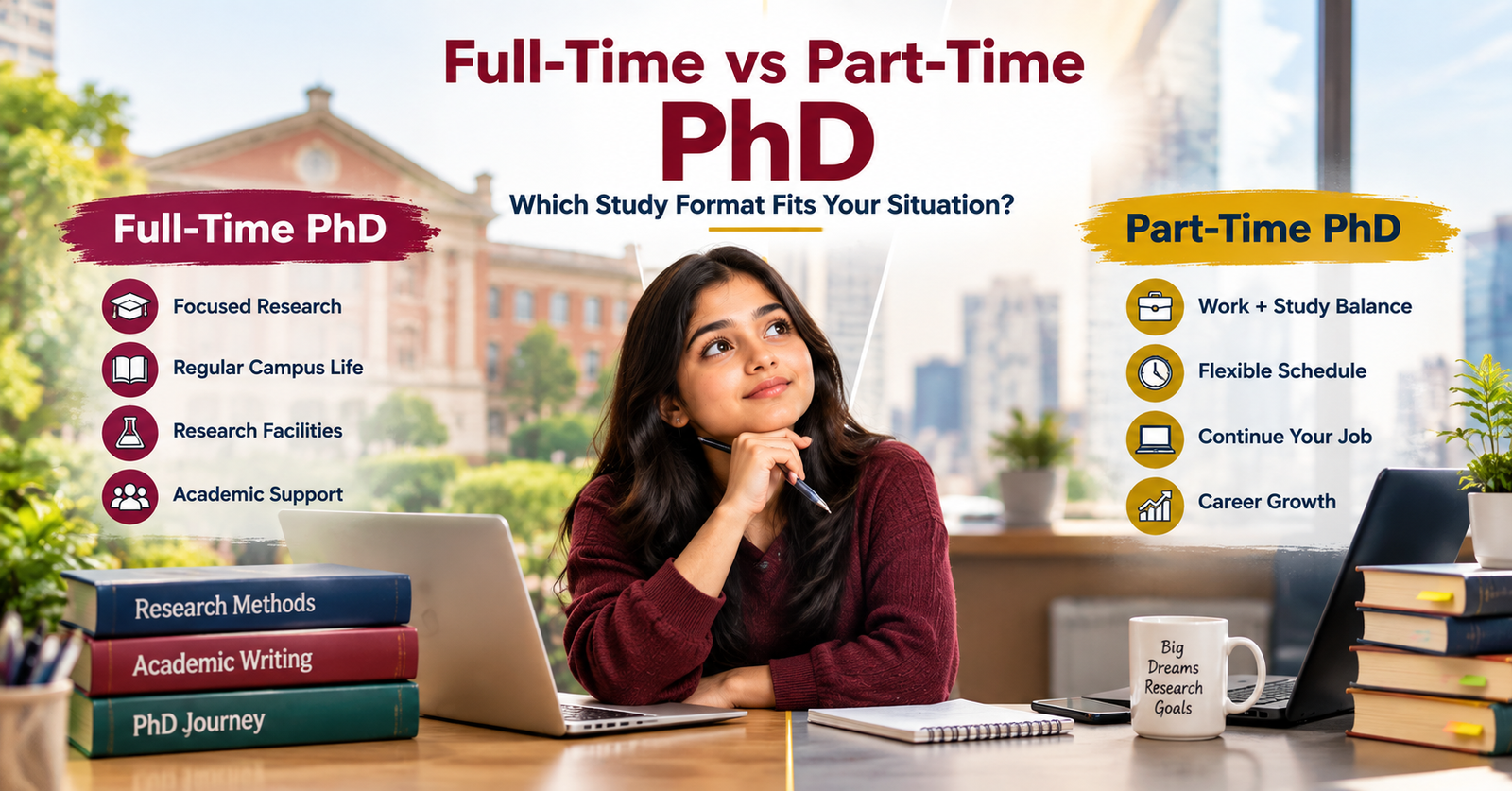
Full-Time vs Part-Time PhD: Complete Guide 2026
Planning to pursue a Doctor of Philosophy degree? Understand the differences between full-time and part-time PhD programmes, including study commitments, research schedules, eligibility, duration and career considerations.
A full-time PhD generally involves dedicating most of your working time to doctoral research and related academic activities. A part-time PhD is designed for eligible candidates who need to combine doctoral research with professional or other responsibilities, subject to the university's rules.
In this guide, we explain the major differences between full-time and part-time PhD programmes in India in 2026. You will learn what to check before applying and how to evaluate which format fits your circumstances.
1. What Is a PhD?
A Doctor of Philosophy, commonly called a PhD, is an advanced research degree in which a scholar investigates a specific research problem and contributes original knowledge to a field. It can be pursued in disciplines such as science, engineering, management, commerce, humanities, law, agriculture and social sciences, depending on the university's approved research areas.
A PhD normally involves research methodology, literature review, coursework where prescribed, progress reviews, research seminars, a thesis or dissertation, and an evaluation or viva voce according to applicable regulations.
2. What Is a Full-Time PhD?
A full-time PhD is a doctoral programme in which the scholar dedicates their primary academic working time to research. Depending on the institution and discipline, the programme may include coursework, laboratory work, teaching responsibilities, research meetings, seminars and collaboration with faculty members.
Full-time research can be suitable for candidates who want to immerse themselves in a research environment and can commit substantial time to their doctoral work.
Key Features of a Full-Time PhD
- Research is generally the scholar's primary commitment.
- Regular participation in prescribed academic activities.
- Potential access to laboratories, libraries and research groups.
- Frequent interaction with supervisors, depending on the institution.
- Possible funding or fellowship opportunities for eligible candidates.
- Progress reports, coursework and thesis requirements as prescribed.
Who May Consider a Full-Time PhD?
- Graduates or postgraduates planning an academic research career.
- Candidates who can dedicate substantial time to research.
- Students interested in research-intensive academic environments.
- Applicants whose financial and personal circumstances support full-time study.
Funding, fellowships, hostel facilities, teaching duties and access to research resources vary by institution and programme. Applicants should confirm these details before accepting an offer.
3. What Is a Part-Time PhD?
A part-time PhD is a doctoral programme intended for eligible candidates who need to combine research with professional employment or other responsibilities. The precise format depends on the university's regulations, the research discipline and the scholar's circumstances.
Part-time does not mean that research requirements are optional or that the qualification has lower academic standards. Scholars must complete the prescribed research work, attend required coursework or academic activities, submit progress reports and fulfil the thesis evaluation requirements.
Key Features of a Part-Time PhD
- Research is managed alongside permitted professional or personal responsibilities.
- Attendance and campus visits follow university requirements.
- Research meetings may be arranged around approved schedules.
- Progress must meet the institution's prescribed milestones.
- Employers may need to provide a no-objection certificate or other documentation where required.
- Minimum and maximum registration periods depend on applicable regulations.
Who May Consider a Part-Time PhD?
- Eligible working professionals interested in advanced research.
- Teachers and academics seeking to develop research expertise.
- Industry professionals whose experience relates to their research topic.
- Candidates who need to maintain employment while studying.
4. Full-Time vs Part-Time PhD: Key Differences
The following table summarises common differences. Actual arrangements can vary significantly between universities, departments and research disciplines.
| Comparison Factor | Full-Time PhD | Part-Time PhD |
|---|---|---|
| Primary commitment | Doctoral research is generally the main academic commitment. | Research is combined with permitted professional or other responsibilities. |
| Employment | Outside employment may be restricted by institutional or fellowship rules. | May accommodate eligible working professionals, subject to university regulations. |
| Research schedule | Often involves regular research activities throughout the working week. | Requires careful planning around work and other commitments. |
| Campus attendance | Follows the university's prescribed attendance and research requirements. | Follows the university's prescribed requirements, which may include scheduled campus visits. |
| Coursework | Must be completed as prescribed by the university. | Must also be completed as prescribed; arrangements depend on institutional rules. |
| Research supervision | Supervisor meetings and research activities are arranged according to programme needs. | Supervisor meetings must be coordinated with the research plan and institutional requirements. |
| Funding | Eligible candidates may have access to applicable fellowships or funding schemes. | Funding availability and eligibility depend on the particular scheme and institution. |
| Duration | Depends on regulations, research progress and thesis completion. | Depends on regulations, research progress and thesis completion. |
| Work-life planning | Requires substantial time for research and academic activities. | Requires balancing research with employment and personal responsibilities. |
| Research standards | Must satisfy applicable academic and research requirements. | Must satisfy applicable academic and research requirements. |
The central difference is usually how the scholar organises their time and commitments. The mode of registration does not remove the need to complete the university's doctoral research requirements.
5. PhD Eligibility Requirements in India
PhD eligibility depends on the applicable national regulations, university admission rules, discipline-specific requirements and the admission notification for the relevant academic session.
Academic Qualifications
Many Indian PhD programmes require a relevant master's degree with a prescribed minimum percentage or equivalent grade. Some programmes may also permit eligible candidates with a four-year bachelor's degree, subject to applicable regulations and the university's admission criteria.
Requirements may differ by subject, applicant category and qualification. Always check the current admission notification rather than relying on a general eligibility summary.
Entrance Examination and Interview
Depending on the university and the applicable admission rules, the selection process may involve an entrance examination, consideration of eligible national-level test scores, an interview or presentation of a research proposal.
Additional Requirements for Part-Time Applicants
- Proof of employment or professional experience, where required.
- No-objection certificate from the employer, where applicable.
- Confirmation that the proposed research can be completed alongside employment.
- Access to required research facilities, data or laboratory resources.
- Compliance with attendance, coursework and supervisor-meeting requirements.
6. Full-Time vs Part-Time PhD Duration
PhD duration is governed by the applicable regulations and university rules. The time needed to complete a doctorate also depends on the research problem, data collection, experiments, fieldwork, publications where required, thesis writing and evaluation.
Under the UGC PhD Regulations, 2022, the general minimum duration is three years, including coursework, and the maximum duration is six years from admission, subject to the provisions of the regulations. Applicable extensions and special provisions must be checked in the current official rules and institutional regulations.
Do not assume that every university uses identical rules for every circumstance. Confirm the current duration requirements directly with the institution before applying.
Factors That Affect Completion Time
- Complexity and scope of the research topic.
- Availability of research data, equipment and facilities.
- Time needed for experiments, surveys or fieldwork.
- Supervisor feedback and progress-review schedules.
- Coursework and other mandatory academic requirements.
- Time available for research alongside employment.
- Thesis examination and required revisions.
Part-time candidates should create a realistic research schedule that accounts for both their professional responsibilities and their university's academic milestones.
7. Can Working Professionals Pursue a PhD?
Yes, eligible working professionals may pursue a part-time PhD where the university offers and permits that mode of registration. Admission remains subject to academic eligibility, selection procedures, departmental requirements and applicable regulations.
A working professional should evaluate the practical demands of research before applying. A doctoral programme can require sustained effort over several years, including literature reviews, research design, data collection, analysis, academic writing and regular progress reviews.
What Should Working Professionals Check?
- Does the university accept part-time PhD candidates in your subject?
- Are your academic qualifications eligible for the programme?
- Will your employer permit the required research activities?
- Is an employer NOC required?
- How often must you attend the campus?
- Are coursework and research seminars held at fixed times?
- Can you access the facilities and data needed for your research?
- Can you consistently dedicate time to research and writing?
8. PhD Admission Process in India for 2026
Admission procedures vary by institution. The following steps provide a general preparation checklist for candidates exploring full-time or part-time doctoral programmes.
Step 1: Identify Your Research Area
Choose a broad discipline and identify a research problem that interests you. Consider your previous qualifications, academic interests, professional experience and the availability of suitable research facilities.
Step 2: Research Universities
Review the official websites and admission notifications of universities offering research in your field. Check whether full-time and part-time registration are available for your intended subject.
Step 3: Check Eligibility
Verify degree requirements, minimum marks, accepted entrance qualifications, application deadlines and any additional conditions applicable to your category or programme.
Step 4: Prepare Your Research Proposal
Develop a clear preliminary research idea. Depending on the institution, your proposal may explain the research problem, objectives, relevant literature, proposed methodology and potential contribution.
Step 5: Complete the Application
Submit the required application form and documents through the official university admission channel. Pay attention to the prescribed deadline and document requirements.
Step 6: Attend the Selection Process
Complete the entrance test, interview, presentation or other selection stages specified by the university. Be prepared to explain your research interest and proposed methodology.
Step 7: Confirm Registration Conditions
Before accepting an offer, review the registration mode, coursework, supervisor allocation, fees, attendance rules, research facilities and duration requirements.
For general guidance on preparing for doctoral admissions, visit AdmissionWork PhD Admission Guidance.
9. How to Choose Between Full-Time and Part-Time PhD
There is no single format that suits every applicant. Consider your personal circumstances, research objectives and the requirements of the university before making a decision.
Consider Full-Time PhD If...
- You can make research your main academic commitment.
- You want regular involvement in a research environment.
- You can meet the programme's attendance requirements.
- Your financial circumstances support full-time study.
- Your intended programme's conditions suit your plans.
Consider Part-Time PhD If...
- You need to continue eligible employment.
- Your professional schedule can accommodate research.
- Your employer permits the necessary academic activities.
- You can meet campus and coursework requirements.
- Your chosen university permits part-time registration.
Questions to Ask Yourself
- How many hours can I consistently dedicate to research each week?
- Do I need to continue working during my PhD?
- Will I have access to the necessary data, equipment and facilities?
- Can I meet the university's attendance and coursework requirements?
- Have I checked the complete fee structure and available funding?
- Does the programme support my intended research area?
- Have I discussed the research plan with the relevant department?
Answering these questions can help you compare programmes based on practical requirements rather than relying only on the full-time or part-time label.
10. Common Mistakes to Avoid Before PhD Admission
1. Choosing a University Without Checking Its Rules
A programme's eligibility, registration mode, coursework, attendance and research facilities should be checked through its official admission documents.
2. Assuming Part-Time Means No Campus Attendance
Part-time registration does not automatically exempt a scholar from coursework, research meetings, progress reviews or other prescribed academic activities.
3. Selecting a Research Topic Without Feasibility Checks
A research topic should be academically relevant and feasible within the available time, resources and expertise. Discuss access to data and facilities with the relevant department.
4. Ignoring Employment Conditions
Working professionals should understand their employment conditions and confirm any required employer approval before committing to a doctoral programme.
5. Assuming Admission or Completion Is Guaranteed
Admission depends on the applicable selection process, and successful completion depends on meeting academic and research requirements. No adviser can guarantee admission, a particular completion date or a doctoral award.
6. Not Reviewing the Total Cost
Compare tuition and registration fees, research expenses, travel, accommodation where needed and other applicable charges. Verify the latest fee schedule directly with the university.
11. Frequently Asked Questions
Q1. What is the main difference between full-time and part-time PhD?
A full-time PhD generally makes doctoral research the scholar's primary academic commitment. A part-time PhD allows eligible candidates to combine research with other responsibilities, subject to university rules. Both modes require the scholar to meet the prescribed academic and research standards.
Q2. Can a working professional apply for a part-time PhD in India?
Yes, if the candidate meets the eligibility criteria and the chosen university offers part-time registration in the relevant discipline. Employment documents or an employer NOC may be required, depending on the institution.
Q3. Is the eligibility for full-time and part-time PhD the same?
Some academic eligibility requirements may be similar, but additional conditions can apply to part-time applicants. The official admission notification should be checked for the exact requirements.
Q4. How long does it take to complete a PhD in India?
Duration depends on the applicable regulations, university rules and research progress. The UGC PhD Regulations, 2022 generally prescribe a minimum duration of three years, including coursework, and a maximum duration of six years from admission, subject to the regulations' provisions. Always verify the rules applicable to your programme.
Q5. Can I continue my job while pursuing a PhD?
This depends on the registration mode, university rules, employment conditions and any applicable fellowship restrictions. Eligible candidates considering part-time research should confirm these conditions before applying.
Q6. Do part-time PhD scholars need to attend coursework?
Part-time scholars must follow the coursework and academic requirements prescribed by their university. The schedule and attendance arrangements should be confirmed with the department.
Q7. Are fellowships available for part-time PhD candidates?
Funding eligibility varies by fellowship, funding agency, university and registration conditions. Do not assume that a fellowship available to a full-time scholar is also available to a part-time candidate. Check the specific scheme's current eligibility rules.
Q8. Can I change from full-time to part-time PhD after admission?
A change in registration mode may be possible only if permitted by the university's regulations and approved procedures. Ask the research department about eligibility, documentation and any effect on registration conditions.
Q9. Does a part-time PhD have the same research requirements?
Part-time registration does not automatically reduce the required academic standards. Scholars must complete the applicable coursework, research milestones, thesis submission and evaluation requirements.
Q10. How do I select a university for my PhD?
Review the university's applicable recognition and regulatory status, programme eligibility, research specialisations, faculty expertise, facilities, fees, registration modes and admission process. Verify details through official university and regulatory sources.
Conclusion: Plan Your PhD Journey Carefully
Choosing between a full-time and part-time PhD requires a clear understanding of your research goals, available time, professional responsibilities and the rules of your chosen university.
Full-time registration generally involves a primary commitment to doctoral research, while part-time registration can provide a route for eligible candidates to combine research with other responsibilities. Neither option removes the need for sustained effort, academic integrity and original research.
Before applying in 2026, compare official admission notifications, confirm eligibility, discuss your research proposal with the relevant department and understand the registration conditions. Careful preparation can help you make an informed decision about your doctoral journey.
Planning Your PhD Admission in 2026?
Explore your research interests, review university admission requirements and prepare your next steps with guidance from AdmissionWork.
Explore PhD Guidance Visit AdmissionWorkLooking for PhD Admission Guidance?
Get free synopsis evaluation & university recommendations.
AdmissionWork
Education & Research Expert • AdmissionWork
Specialist in doctoral research consulting, UGC compliance protocols, and thesis formulation.